The Challenge of Educating for an Acceptable Digital Technology

In 2021 I wrote a piece called "Yes to digital education, but not just any digital, and not just any way of teaching it." I wrote it in a fit of frustration, as is sometimes the case with my most pointed articles, in reaction to the launch of a French government program placing "digital advisors" (conseillers numériques*) in local communities to help residents with everyday tech use. I wanted to put into words my deep unease with the idea that education, across a person's whole life, whether in schools, universities, or digital-inclusion and outreach work, should simply consist of accompanying, without flinching or asking questions, the world's runaway digitization. Underpinning that idea is a false and deterministic belief: that this is simply "the direction of progress," that "there's no alternative." A digitization of the world that we never actually chose, whose shape was never debated, and which has an enormous blind spot around its material, geopolitical, ecological, and social sustainability.
*Translation note on context for non-French readers: "Conseillers numériques" refers to a French state-funded program (launched 2021) that deployed thousands of digital mediators across France to help residents with digital skills and administrative tasks online.
I wrote that piece because, in my view, we could no longer go on educating (or training people) as if nothing had happened. As if "digital technology," in becoming so pervasive, hadn't given rise to Big Tech, and more broadly, to digital multinationals as powerful as many nation-states. As if today's largely oligopolistic digital platforms hadn't become deeply alienating, even toxic, for society, driven by economic interests and ideologies incompatible with the public good. As if "digital technology" had no ecological or social impact. As if digitization hadn't added a further layer of difficulty for people who are already vulnerable, not to mention an infrastructure that keeps growing more centralized and less resilient. In short: digital education, broadly defined, could no longer simply accompany, and thereby encourage, the world's digitization without also criticizing it, rethinking it, questioning it, and transforming it.
Also worth reading: educating for digital technology, between "moral panic" and techno-reassurance.
Today, amid overlapping geopolitical, political, ecological, and social crises, I want to say this again, and say it forcefully: yes to digital education, but not just any digital, and not just any way of teaching it. Not just any digital: an acceptable digital technology. And not just any way: an education that is technocritical, political, emancipatory, and rooted in popular education traditions. Across the whole of life.
Table des matières
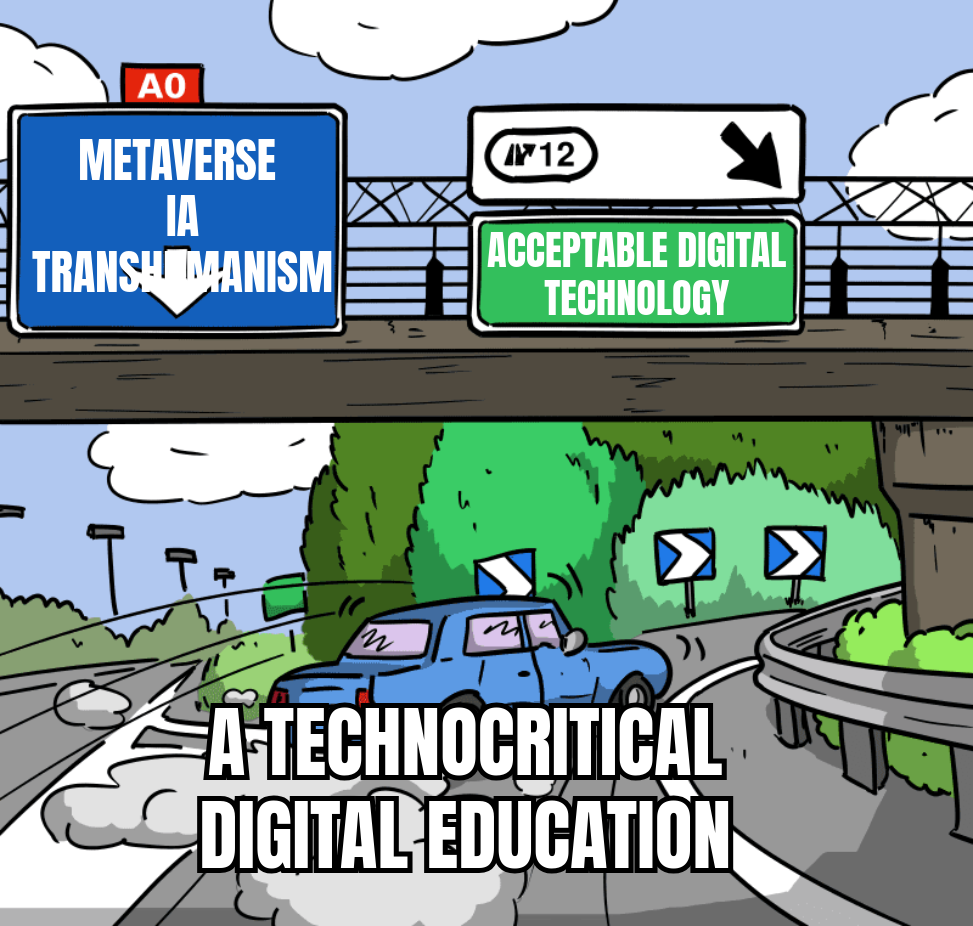
Not just any digital: toward an acceptable digital technology
Since 2022, I've proposed talking about acceptable digital technology rather than responsible digital technology. "Responsible digital" has become a problematic oxymoron, watered down further with each passing day (see my dedicated article on the term). In its place, I proposed a more radical and more systemic concept: digital technology that is acceptable.
More radical, because the word "acceptable" makes explicit that all digital infrastructure carries a real ecological and social cost that can no longer be ignored. Digital technology only becomes acceptable, then, if, and only if, it remains socially and ecologically sustainable (which necessarily implies political choices), and if it is genuinely beneficial, useful, and above all emancipatory for society.
More systemic, because "acceptable digital" brings together both the question of ecological and social impact and the question of emancipation and democratic choice. For digital technology to be acceptable, it has to be emancipatory, democratically chosen, and sustainable, all at once.
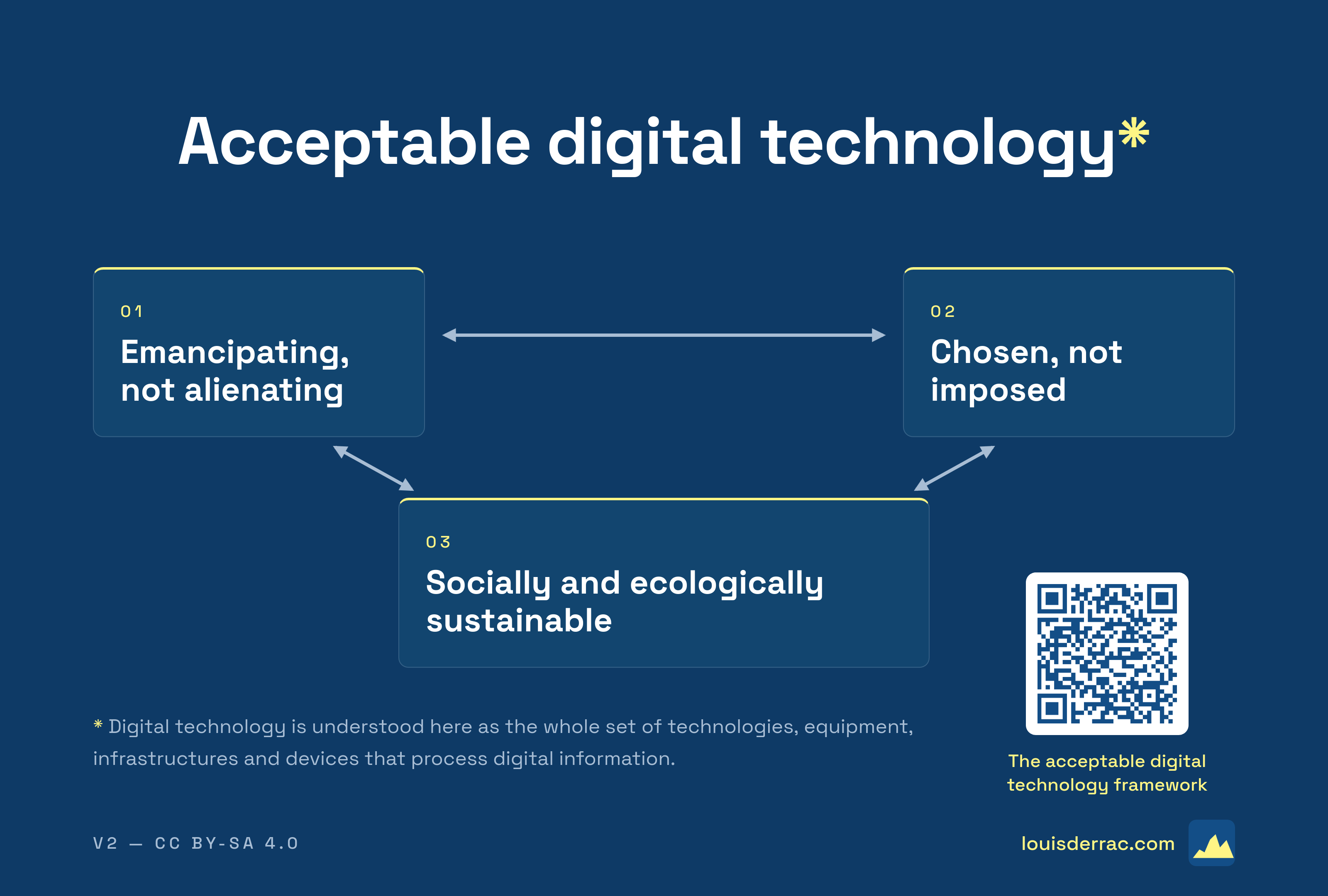
Thinking in terms of "acceptable digital" also opens up two complementary levels of reflection. Digital technology considered outside the ecological and social limits of our current era invites a philosophical and ethical approach: what is the rightful place of digital technology in society? Digital technology considered within those ecological and social limits, on the other hand, demands a political approach: what kind of technical democracy do we want? How do we decide what digital technology to permit, regulate, or forbid?
Not just any way: a (technocritical) digital education
For digital education to be more than just a support system for digital transformation, it has to be technocritical. A few reminders are useful here.
Technology is neither good, nor bad, nor neutral
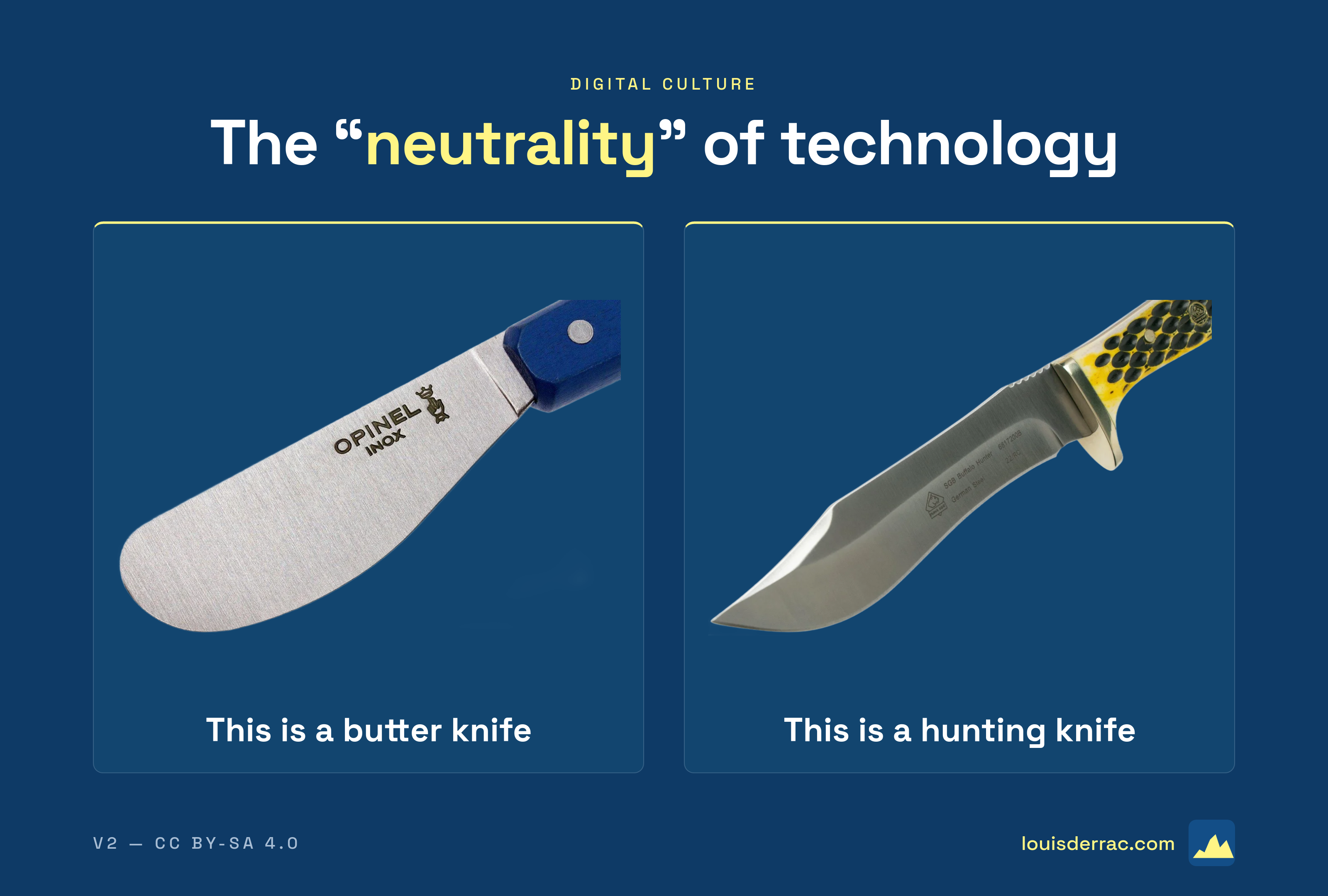
This formula, coined by historian of technology Melvin Kranzberg, deserves to be taught and shared far more widely. Neutrality is a myth: every technology carries values, biases, and power dynamics within it, affordances that shape what is possible. It isn't a simple tool; it's a social actor that reshapes human relationships, economic structures, and ways of thinking. To say it isn't neutral is to recognize that it becomes political from the moment it's designed, and that it's up to us, as citizens, to reclaim it, question it, and redirect it. As writer and activist Cory Doctorow puts it, the trouble with a technology isn't what it does, but who it does it for and who it does it to.
Also worth reading: "Tools are neutral, take this knife, for example."
Technical progress is not linear
Contrary to the popular idea of a continuous ascent, from stone tools to steam engines to smartphones, technical progress follows no straight or inevitable path. It's marked by ruptures, delays, dead ends, and even regressions. Some technologies disappear; others are abandoned not for lack of effectiveness but for lack of economic or political interest. History is full of promising inventions left in a drawer, or lost know-how: Roman techniques for hydraulic concrete, or pre-Columbian irrigation systems, are classic examples. Progress isn't a triumphant march forward; it's a rugged landscape, shaped by chance, crisis, and human choices. There's no automatic "forward march", only directions that are chosen, or far more often, imposed.
Technical progress is not predetermined
The history of technology teaches us that there's no such thing as technological destiny. Innovations don't arise as inevitabilities; they're products of social, economic, cultural, and political context. Technology doesn't dictate the course of history, it's the other way around. The smartphone was never destined to become a tool of mass surveillance, nor was AI destined to become a machine for optimizing productivity at the expense of wellbeing. These uses are the result of decisions, interests, and power struggles. Technical progress isn't a law of nature, it's a human construction, and therefore something that can be changed, contested, and redirected.
Technical progress ≠ social progress
It's tempting, even comforting, to believe that the more technology advances, the more society improves. But that equation is false, and dangerous. A tool can be technically "revolutionary" without being emancipatory. There's no automatic link between technical innovation and better living conditions. Quite the opposite: without regulation, without ethics, without technical democracy, technical progress can widen inequality, accelerate exploitation, and undermine the very conditions that make life in common possible. Real social progress is the kind we decide on together, not the kind we passively endure.
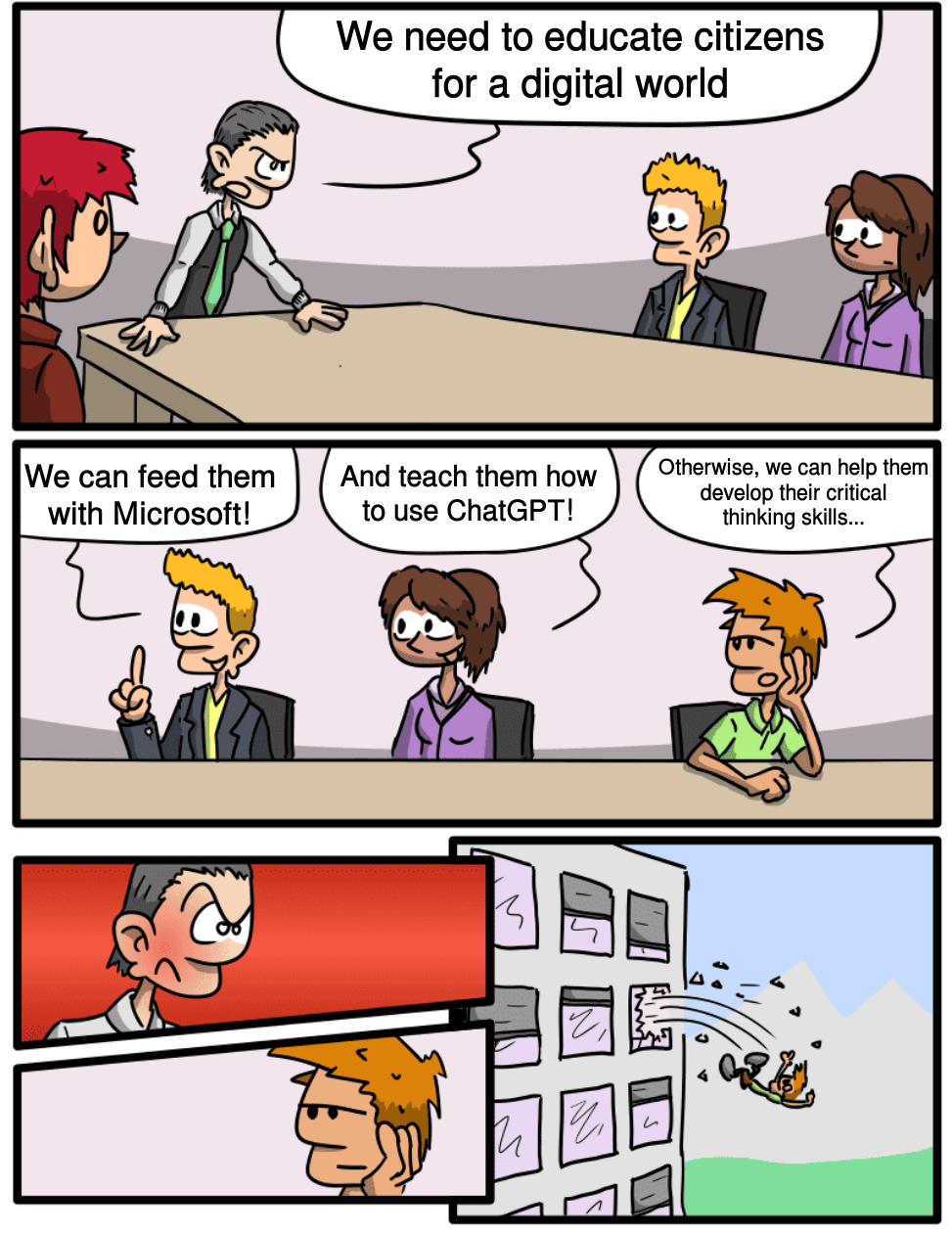
Educating people to think critically about digital technology, in this sense, is a way of living out a beautiful idea I've paraphrased from philosopher Bernard Stiegler: understand digital technology in order to critique it, and to transform it. To understand digital technology, you need to build up your digital literacy and skills. To critique it, you need to develop critical thinking and an understanding of its many stakes. And finally, to transform it, you need to develop imagination and a sense of agency: voting, protesting, signing open letters, organizing, building alternatives, and so on.
And in practice?
I do occasionally lead workshops for various audiences, but that's fairly rare in my work. So I have no intention of lecturing teachers and digital-outreach workers, who understand far better than I do how to design lesson plans for a technocritical digital education, and whenever I have something useful, I share it too, notably on my wiki, Numériquoi. But here are three illustrations to give you a sense of the shift in posture I'm proposing.
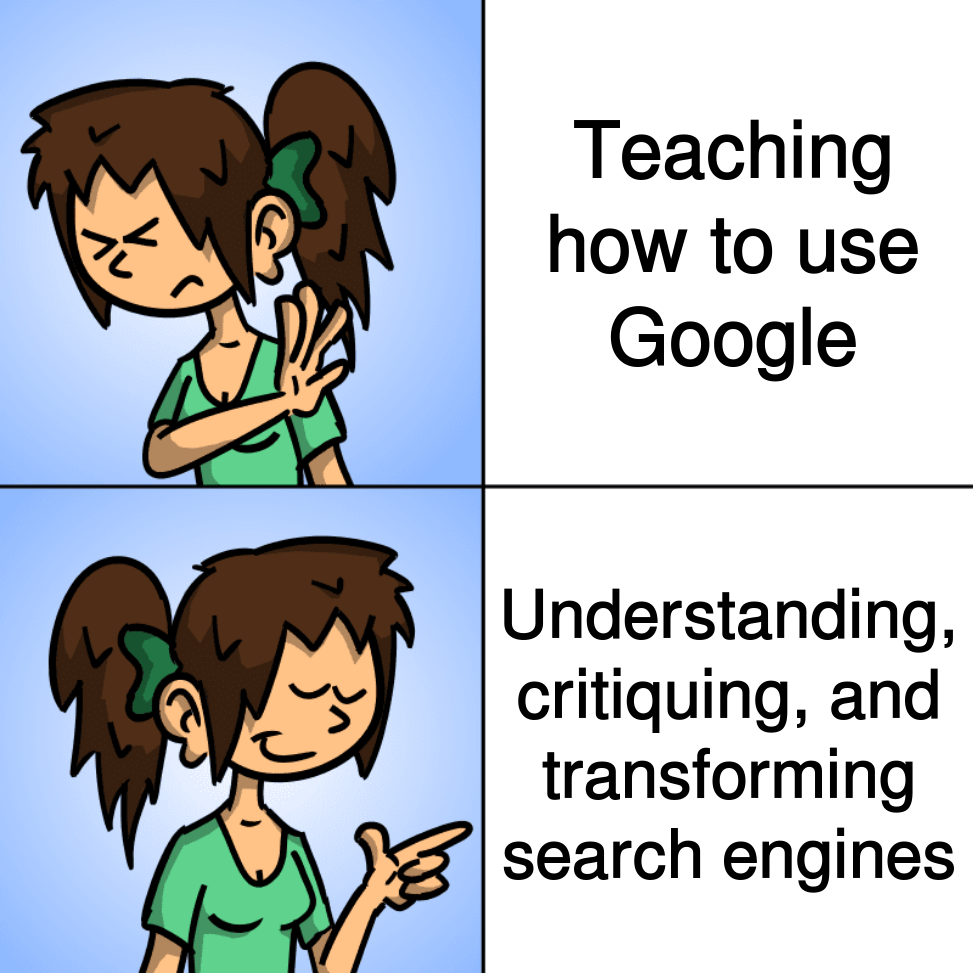
Teaching how to use Google vs. understanding, critiquing, and transforming search engines
The idea here is to move beyond teaching a specific search engine (Google, for instance) toward learning the broader principles behind it, shifting from a passive, alienated way of using it to a much richer range of reflective, emancipatory practices.
That means first understanding, technically and economically, how search engines work. Then, critiquing the limits of having search engines mediate our access to information. And finally, discovering more ethical alternatives: DuckDuckGo, Qwant, Kagi, Mojeek, Clew, and others. Or better yet, imagining one's own alternative, built on a different economic model.
Installing an ad blocker vs. understanding, critiquing, and transforming surveillance capitalism
Beyond the fix for the immediate problem, in this case, targeted advertising, it's essential to understand and question its underlying causes: surveillance capitalism, and the economic model built on ultra-targeted advertising and the harvesting, use, and resale of personal data.
This can take the shape of classroom debates (with or without assigned roles), or of exercises in imagining and designing alternatives.

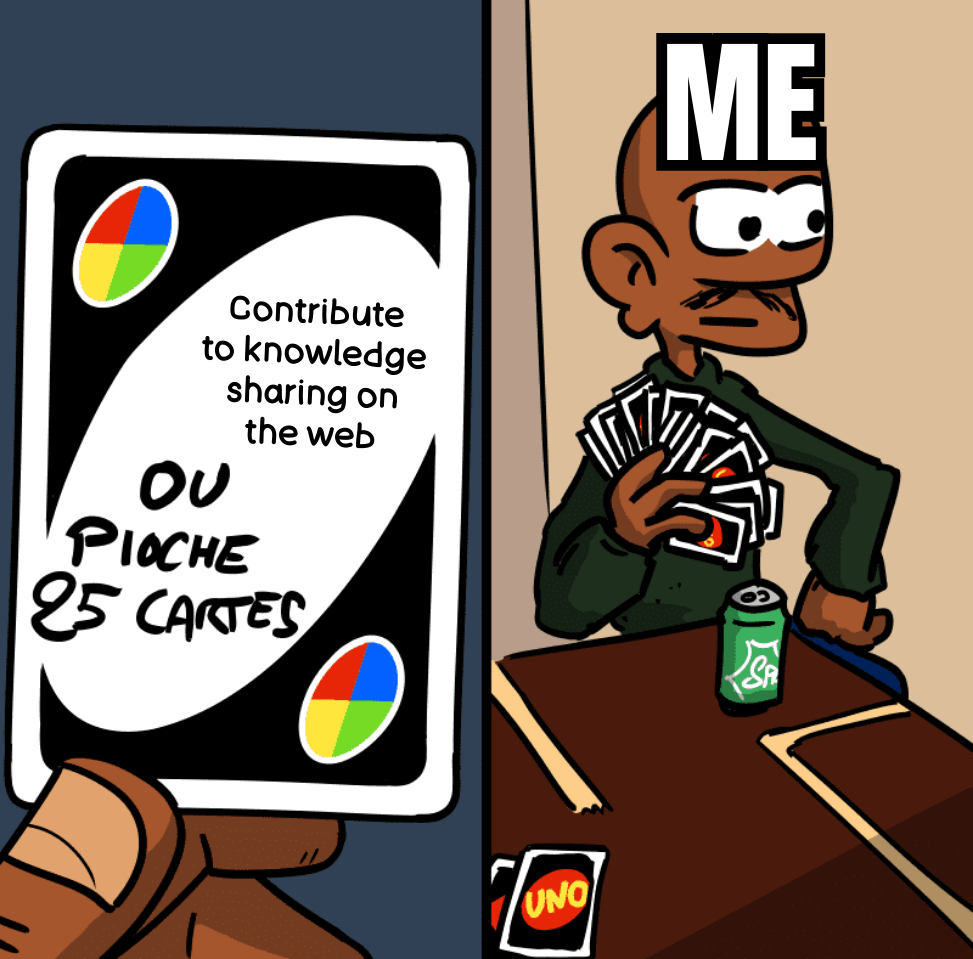
Teaching passive consumption, or contributory and emancipatory practices?
From a once-utopian space for sharing, the web has become a supermarket. People online share less and less, and passively consume more and more. I think it's essential to pass on contributory, emancipatory practices instead.
A few examples of ways to contribute to the web: writing or editing Wikipedia articles, creating web radio shows or web zines, contributing to free and open-source software, taking part in online communities, creating and sharing original memes, and so on. In truth, the possibilities are endless. What matters is creating and sharing. What matters is learning to publish, with all the media literacy that implies.
Conclusion
As media scholar Fred Turner once put it: there was never a utopian internet, there were only stories about an internet that was supposed to make America utopian, but they were only stories. That myth, sold by a Silicon Valley eager to present itself as progressive, has now definitively collapsed. Thanks to the work of historians, sociologists, and political scientists, we now know that these technologies have always been shaped by economic interests, power, and ideology. None of it was ever neutral, predetermined, or inevitable.
At the same time, we can no longer ignore the limits: ecological, social, human. We know digital technology has a cost: it pollutes, it divides, it concentrates power. This is no longer a question of "progressing," but of choosing: what kind of digital technology do we want, built by whom, for whom, at what price? And that's where education comes in.
Educating people about digital technology isn't just about teaching them to use it, it's about helping them understand it, critique it, and transform it. It means forming citizens capable of saying: no, this isn't acceptable, and here's something else we could build instead. Not enduring it, but reinventing it. That's the real challenge, the challenge of educating for an acceptable digital technology.
D'autres articles à lire :

Digital literacy is fine. But not just any digital literacy, and not for any purpose - K12 and schools
This is the English translation of my article Éduquer au numérique d’accord. Mais pas n’importe lequel et pas n’importe comment – Partie 2 : l’enseignement…

Opinion: "Digital solutionism will not save the school"
This article was originally published on the Le Monde website (see the article). With their permission, I reproduce it on my site. It continues the…

What place should be given to digital technology in the "school after tomorrow"? [Feat Le Mouton Numérique]
The place of digital technology in education is a subject that has fuelled both specialised and generalist news in recent months. This article, co-published with…